By Keshavan Thiagaraja
I have the honour of writing about Professor Rajendra Surenthirakumaran, not only because he is a respected public health academic and the current Dean of the Faculty of Medicine at the University of Jaffna, but because I knew him long before the titles, research papers and responsibilities of academic leadership.
We studied together at Jaffna Hindu College. He was living with his parents in Chulipuram. I was living with my parents in Chankanai. Our school days unfolded during one of the most difficult periods in Northern Sri Lanka, when conflict, economic restrictions and shortages shaped ordinary life.
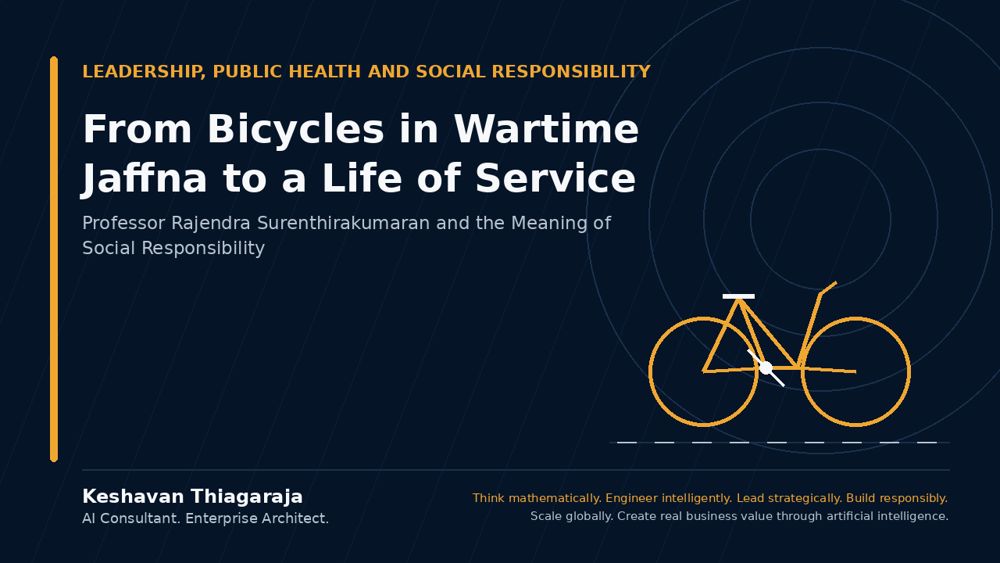
There was no easy transport. Fuel was scarce. Electricity was unreliable or unavailable for long periods. A motorbike or scooter was not a realistic daily option for us. So we travelled by bicycle.
Rajendra would come from Chulipuram. I would come from Chankanai. Most probably, along the way, we would join our friends Pathan and Jeyavigithan, and together we would continue the journey to Jaffna Hindu College in Jaffna.
We did not have much. But we had friendship, ambition, education and the determination to keep moving forward. Looking back, those bicycle journeys now feel like more than a memory. They were early lessons in resilience.
1. Before the titles, there were bicycles
Today, it is easy to see Professor Surenthirakumaran through the language of achievement: MBBS, MSc, MD, postgraduate training, professorship, research, international collaboration and the deanship of a medical faculty.
But achievement is easier to understand when we remember the conditions from which it grew.
Our generation in Jaffna learned to study through disruption. We learned to plan around shortages. We learned that a school day could require physical effort before the first lesson even began. We learned that progress was rarely convenient.
That experience matters because resilience is not a slogan learned later in a leadership course. For many people who grew up through the conflict in Northern Sri Lanka, resilience was part of daily life.
The bicycle journey from Chulipuram and Chankanai to Jaffna was not heroic in our minds at the time. It was simply what we had to do. Yet it represents something important. When circumstances remove comfort, purpose becomes visible.
2. Education under pressure
Even when we had little, we enjoyed studying.
That sentence is important to me because it captures what education meant in those years. Education was not merely a pathway to employment. It was hope, discipline and a form of continuity when the world around us was uncertain.
Professor Surenthirakumaran carried that commitment into medicine. He graduated from the Faculty of Medicine, University of Jaffna, and later developed a career in Community Medicine, a field that asks a broader question than how to treat one patient at a time.
It asks how communities become healthier. It asks why some people struggle to access care. It asks how health systems can respond to poverty, displacement, chronic disease, psychological distress and social conditions.
That is where his professional story becomes closely connected with social responsibility.
3. Social responsibility as a professional practice
Corporate social responsibility is often discussed in boardrooms as a programme, a budget, a report or an annual commitment.
Professor Surenthirakumaran's career offers a wider lesson. Social responsibility becomes more powerful when it is not an occasional project, but a professional habit.
His work has remained rooted in the realities of Northern Sri Lanka. His academic profile and publication record span health systems, social determinants of health, ageing, palliative care, mental health, cancer prevention and atrial fibrillation research.
The common thread is not the disease category. It is the human question underneath it: how can evidence be used to make care more accessible, more effective and more humane?
This is public health at its best. Research does not end when a paper is published. It should inform services, strengthen communities and improve the decisions made by institutions.
4. Giving visibility to post-conflict health
One of the most important dimensions of his research has been the health of people living with the long consequences of conflict.
Collaborative studies involving Northern Sri Lanka have examined mental disorders in primary care, post-conflict stressors, healthcare use and the psychological consequences that can continue long after active fighting ends.
This matters because a ceasefire or the end of armed conflict does not automatically end bereavement, economic insecurity, displacement, family disruption or psychological distress.
Research gives these experiences visibility. It converts suffering that may otherwise remain private into evidence that health systems can recognise and respond to.
For a region that experienced years of conflict, being represented accurately in the scientific literature is itself important. It tells policymakers, clinicians and the international research community that local realities deserve serious attention.
5. From epidemiology to real health-system change
Another strength of Professor Surenthirakumaran's work is the progression from identifying a problem to asking how the system should respond.
His collaborations on atrial fibrillation illustrate this clearly. The research has moved across prevalence, screening, digital diagnostic technologies, patient and provider experiences, referral pathways and economic evaluation in lower resource settings.
The systems lesson is significant. Measuring a condition is only the first step. The harder questions follow: can people be screened early, can they reach the right clinician, can the service be sustained, and can the health system afford the intervention?
This is the difference between research that describes the world and research that helps redesign it.
6. Palliative care, cancer and dignity
His contribution also extends into palliative care and cancer control.
These areas reveal something essential about the ethics of healthcare. Success cannot be measured only by cure. It must also be measured by relief of suffering, dignity, communication, family support and access to care close to home.
The Faculty of Medicine profile records his work on the development of palliative care services in Northern Sri Lanka and on strategic cancer planning. University activities also show his involvement in evidence-based cancer control, early detection and palliative care discussions for the Northern Province.
For patients and families facing advanced illness, this is not an abstract academic subject. It is the difference between being treated as a diagnosis and being cared for as a human being.
7. Teaching is also a form of service
A professor's influence cannot be measured only by the number of publications carrying his name.
It also lives in the students he teaches, the young researchers he guides, the clinicians he encourages to ask better questions and the teams that learn how to turn local problems into rigorous research.
That multiplier effect is one of the most important forms of academic social responsibility.
A single research project can produce one result. A teacher who develops the capability of many researchers can influence a region for decades.
As Dean of the Faculty of Medicine, Professor Surenthirakumaran now carries this responsibility at an institutional level. Leadership in a medical faculty is not only about administration. It is about protecting standards, developing future doctors, strengthening research culture and ensuring that education remains connected to the health needs of society.
8. Rooted in Jaffna, connected to the world
There is another lesson in his journey.
Remaining rooted in a local community does not require thinking locally.
Professor Surenthirakumaran's work has connected Jaffna with national and international collaborators across public health, cardiovascular research, implementation science and medical education. Recent atrial fibrillation research has included comparative and health-economic work across multiple countries.
This matters for universities outside the world's traditional centres of academic power. Knowledge does not need to originate in London, Boston or Singapore to matter globally.
A health question asked in Jaffna can contribute to international science. Equally, global collaboration can bring methods, networks and opportunities back to Jaffna.
When those relationships are equitable, local service and global relevance strengthen each other.
9. What CEOs and institutional leaders can learn
Professor Surenthirakumaran's story also contains lessons for leaders outside medicine.
First, responsibility must be connected to lived reality. Organisations should not design social impact from a boardroom alone. They need to understand the communities affected by their decisions.
Second, capability matters more than visibility. A public campaign may last a week. A trained clinician, a mentored researcher or a stronger care pathway can create value for years.
Third, local commitment and global ambition are not opposites. The strongest institutions can solve problems close to home while participating in international networks.
Fourth, resilience should be designed into systems before crisis arrives. Those of us who studied in Jaffna during conflict learned what happens when electricity, fuel, transport and normal routines cannot be assumed. Modern organisations should learn the same lesson before disruption forces it upon them.
Fifth, leadership should create successors. The most durable legacy is not personal recognition. It is the capability that remains in other people.
The comparison is simple. Visibility versus impact. Donation versus capability. Short-term intervention versus long-term institution building. Reputation versus responsibility.
Strong social responsibility chooses the second side of those pairings.
10. The journey continues
When I think about Professor Rajendra Surenthirakumaran today, I do not begin with the Dean's office.
I remember the bicycles.
I remember the road from Chulipuram and Chankanai towards Jaffna. I remember friends joining along the way. I remember a time when our material circumstances were limited, but our desire to learn was not.
None of us travelling those roads as schoolboys could see exactly where life would take us.
Today, one of those schoolboys is a Professor in Community Medicine and Dean of the Faculty of Medicine at the University of Jaffna. More importantly, his work has remained connected to the health, dignity and wellbeing of people.
For me, that is what makes his journey worth writing about.
Titles matter. Publications matter. Leadership positions matter. But service gives them meaning.
I am honoured to recognise my former Jaffna Hindu College schoolmate, Professor Rajendra Surenthirakumaran, for a career that demonstrates a simple principle: knowledge reaches its highest value when it is placed at the service of humanity.
And perhaps that is the question for all of us, whether we lead a university, a hospital, a company or a community: when people look back at our work, will they remember what we achieved for ourselves, or what we helped make possible for others?
#ProfessorRajendraSurenthirakumaran #UniversityOfJaffna #FacultyOfMedicine #Jaffna #JaffnaHinduCollege #PublicHealth #CommunityMedicine #MedicalEducation #SocialResponsibility #CorporateSocialResponsibility #CSR #HealthcareLeadership #PalliativeCare #MentalHealth #CancerControl #HealthSystems #ResearchLeadership #NorthernSriLanka #Education #Leadership
Originally published on LinkedIn by Keshavan Thiagaraja. Read the original on LinkedIn.