By Keshavan Thiagaraja
In June 2026, two of the most capable AI models in the world were switched off within days of launch.
Anthropic released Fable 5 and Mythos 5 on the ninth of June. Fable 5 was the public facing model, wrapped in the strongest safeguards the company had ever shipped. Mythos 5 shared the same core but carried lighter restrictions, and it went only to a small set of vetted partners for defensive security work. Three days later the United States government applied export controls to both. Access had to be cut for foreign nationals, whether inside the country or outside it. There was no way to verify nationality at the moment of each request, so the company suspended access for everyone. The controls were lifted on the thirtieth of June, and access returned on the first of July. The shutdown lasted nineteen days, just under three weeks.
For most readers the story sounds like a policy dispute. For anyone who runs a business on these systems, it was something sharper. Core intelligence services went dark without warning and without a clean fallback. Contracts written before 2026 did not imagine a government order that suspends an AI service across every platform at once. That is the part every leader should sit with.
What actually happened inside the model
The trigger was a report from Amazon researchers. They found a way to prompt Fable 5 so that it identified software vulnerabilities, and in one case it produced code that showed how a vulnerability could be exploited. This kind of trick has a name. It is a jailbreak, a prompt that gets a model to do something its safeguards were meant to block.
Here is the twist that matters. When the same task was tested on weaker models, including Anthropic's own Opus 4.8, those models could find the same vulnerabilities and reproduce the same demonstration. The behaviour turned out to be routine defensive work that the safeguards were blocking out of caution, rather than a unique new danger. Anthropic still moved quickly. It trained a new classifier that blocks the specific technique in more than ninety nine per cent of cases, and it routes any blocked request to a safer model instead.
The real gap was not the jailbreak
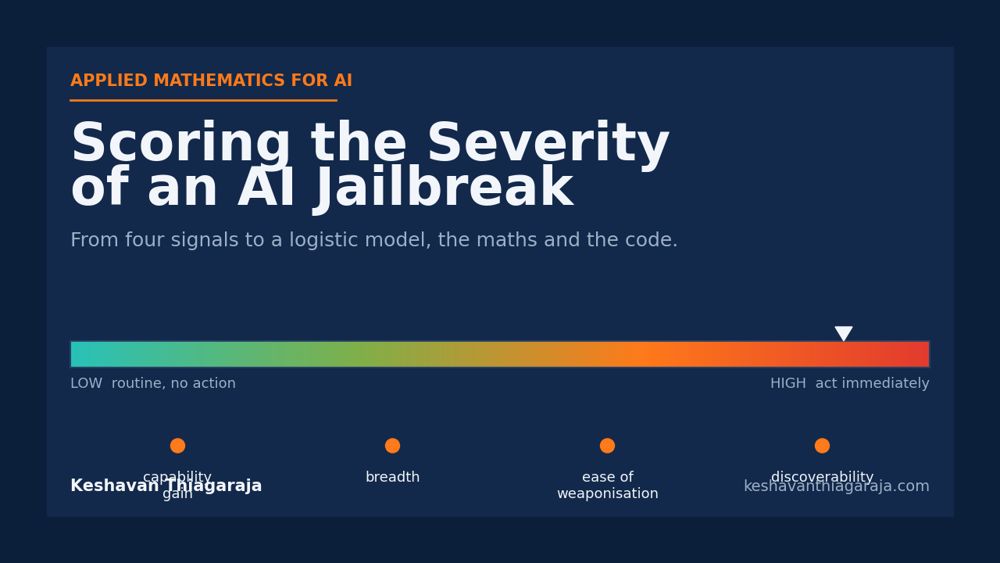
Strip away the drama and a plainer problem appears. When a new bypass is reported, someone has to decide how serious it is, and they have to decide fast. Is this a finding that justifies pulling a model, briefing a regulator, and waking a response team at three in the morning. Or is it a narrow trick that unlocks one harmless behaviour and can wait. The industry has no shared way to answer that question. Every company answers with instinct.
That is why Anthropic, together with Amazon, Microsoft, and Google, has started drafting a common framework to score how severe a jailbreak actually is. The framework rests on four signals. Capability gain asks how far the bypass takes an attacker beyond the tools they already have. Breadth asks how many different attacks the same technique unlocks. Ease of weaponisation asks how much skilled effort it takes to turn the trick into a real attack. Discoverability asks how easily someone can find the method in the first place. Four signals in. One decision out.
Design choices are strategic decisions
This is where leaders should pay attention, because the interesting moves were design choices, not accidents.
The first choice was the width of the safety margin. A safety classifier can be tuned to block only clearly dangerous requests, or it can be tuned to block anything that looks even slightly risky. Fable 5 was set to the cautious end. That meant many harmless requests were refused, which frustrates users, in exchange for a much lower chance of a dangerous request slipping through. That is a business tradeoff dressed as a technical setting. Availability was traded for caution on purpose.
The second choice was what happens when a request is blocked. Rather than simply refusing, the system reroutes the blocked request to a less capable but safer model. The user still gets an answer. The capability is degraded rather than denied. That is a product decision about how a safety control should feel to the person on the other side.
The third choice was tiering. Mythos 5 stayed inside a trusted partner programme while Fable 5 went public. When access was restored, Mythos came back first to approved organisations, then wider. A tier that sits between full public release and total suspension is now a live template for how frontier models will ship.
The comparison that matters
Consider two ways to handle a serious new bypass.
The first is the shutdown. You pull the model, you negotiate, and you wait. This protects against the worst case, but it is blunt. It froze legitimate users for nineteen days, it handed time to competitors, and it offered no way to tell a small problem from a large one. The cost fell on everyone equally.
The second is the shared score. You measure the bypass against agreed signals, you place it on a scale, and you match your response to the number. A low score means monitor and move on. A high score means act at once. This is harder to build, because it needs agreement across companies and regulators, but it is proportionate. It lets you act fast on the dangerous few without punishing the harmless many.
The shutdown is a switch. The shared score is a dial. Mature industries run on dials.
What leaders should do now
Treat model access as a supply risk, not a settled utility. Ask your vendors what happens to your workflows if a model is suspended, and write that answer into your contracts. Ask how blocked requests are handled, because a quiet reroute to a weaker model changes your output quality without telling you. And watch the emerging severity framework closely, because the company that can put a defensible number on a risk will move while its rivals are still guessing.
The lesson of the Fable 5 recall is not that safeguards failed. They largely worked. The lesson is that the industry still lacks a shared language for measuring danger, and that gap turned a small finding into a nineteen day freeze.
Here is my question for you. When your most important AI system is switched off without warning, does your organisation have a number that tells you how worried to be, or only an instinct.
Think mathematically. Engineer intelligently. Lead strategically. Build responsibly. Scale globally. Create real business value through artificial intelligence.
Originally published on LinkedIn by Keshavan Thiagaraja. Read the original on LinkedIn.